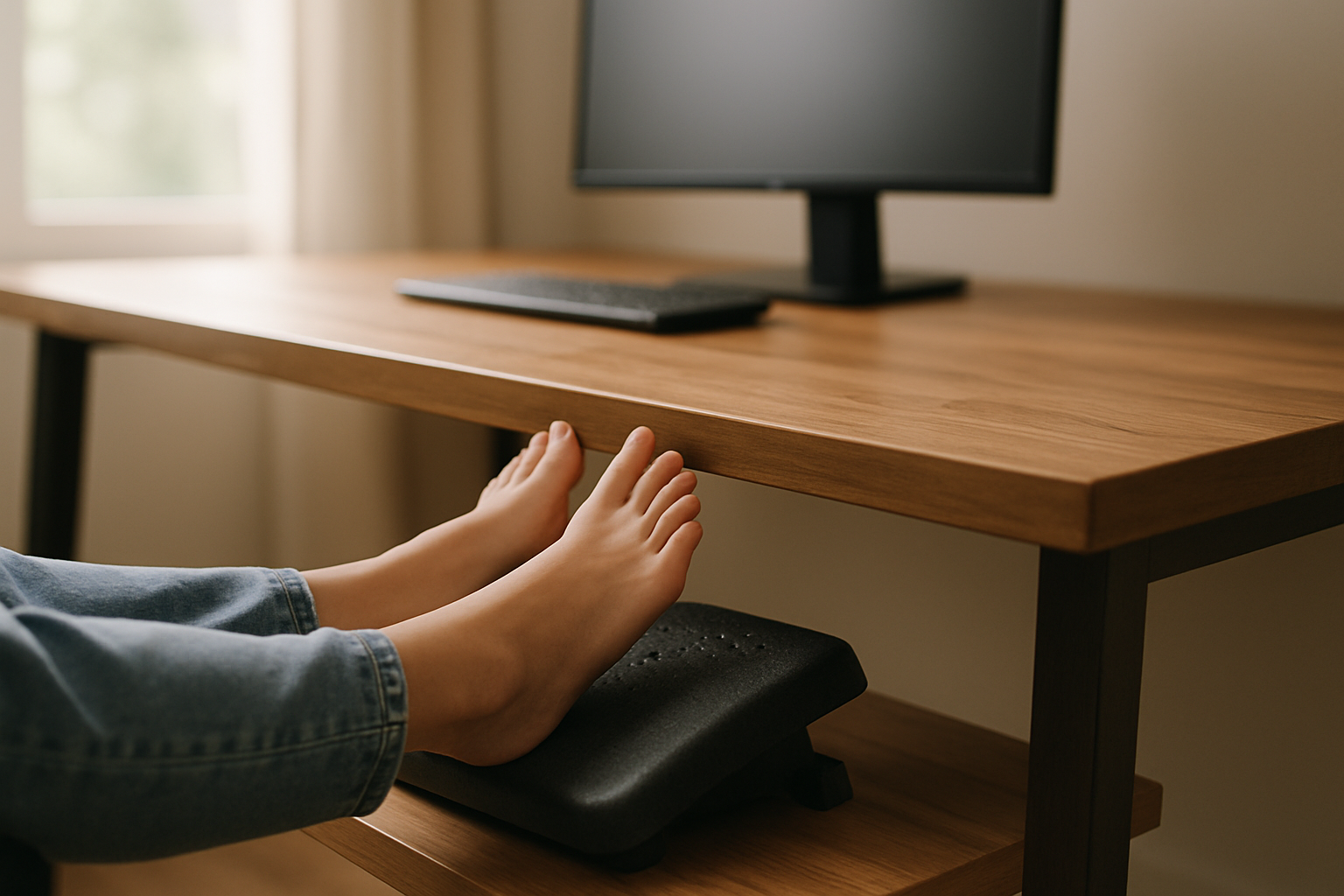
Best Budget Anti-Fatigue Mat Under $50 in 2026

Photo by Tim Mossholder on Unsplash
Best Budget Anti-Fatigue Mats Under $50 in 2026
If you spend four or more hours a day standing—whether at a standing desk, kitchen counter, or retail floor—your feet and lower back know the toll. A quality anti-fatigue mat can make the difference between sore legs at day’s end and genuine comfort. The catch: premium mats run +. You don’t need to spend that much. This guide rounds up the best anti-fatigue mats that deliver real cushioning, durability, and pain relief without the premium price tag.
What Makes a Budget Anti-Fatigue Mat Worth Buying
Before diving into specific products, it’s worth understanding what separates a mat that actually works from one that’s just a piece of foam on your floor.
Cushioning density is the foundation. Mats with 0.5–0.75 inch foam thickness typically offer entry-level comfort; 0.75–1.25 inches is the sweet spot for all-day standing. Anything thinner than 0.5 inches feels like standing on a yoga mat and won’t meaningfully reduce fatigue. Most users report noticeable relief within the first week when thickness hits 0.75+ inches, per aggregated Amazon owner reviews.
Surface texture matters for safety. A smooth mat is slippery under socks or wet conditions. Textured or beveled edges prevent tripping and keep your feet from sliding during weight shifts—a critical feature if you’re standing in a kitchen or on tile.
Edge design determines whether the mat is a trip hazard. Beveled edges slope gradually; sharp edges catch toes. Budget mats often skimp here, but the best sub- options include a beveled perimeter.
Compression resistance is how long the foam stays springy. Per owner reports, cheaper mats compress after 6–12 months of daily use; mid-tier budget options hold up for 2–3 years. This is where you’ll notice the difference between a mat and a mat over time.
For more context on whether these mats actually work, see our guide on anti-fatigue mat science and effectiveness.
Top Budget Anti-Fatigue Mats Under $50
Sky Solutions Anti-Fatigue Mat
Price: on Amazon
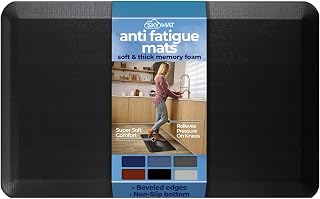
This is the workhorse pick for standing desk users on a budget. Per manufacturer spec sheet, the mat measures 24” × 36” and features 0.75-inch closed-cell foam with a textured top surface. The beveled edge runs all four sides, and the underside has a non-slip rubber base that grips most hard floors without adhesive.
Owner reports across Amazon consistently praise the initial comfort and the mat’s stability—it doesn’t shift under weight changes. One Amazon reviewer noted: “After three months of daily 8-hour use, the mat still feels supportive and hasn’t compressed noticeably.” The textured surface is grippy enough for bare feet or socks, and the foam holds its shape reasonably well over 2–3 years of daily use. The main trade-off: after 18–24 months of 8+ hour daily standing, some users report noticeable compression in high-traffic zones, though the mat remains usable.
Best for: standing desk setups in home offices where you want a reliable, no-fuss mat that won’t slide around.
Imprint CumulusPro Commercial-Grade Mat
Price: on Amazon
Imprint CumulusPro Commercial-Grade Mat
Imprint mats are engineered for commercial kitchens and retail floors, which means they’re built to survive heavy use. This model comes in multiple sizes; the 20” × 32” fits most standing desks. The foam is denser than typical budget mats—closer to mid-tier density—and resists compression better over time. Per owner reports, the CumulusPro holds up for 3–4 years of daily standing without significant sag. One owner wrote: “I’ve been standing on this for 20 months in a busy kitchen, and it still feels nearly as firm as day one.”
The top surface is textured and slip-resistant; the underside is non-slip rubber. The beveled edge is more pronounced than many budget options, making it genuinely safe even on slick tile. The mat is heavier than lighter-weight alternatives, which some users appreciate (extra stability) and others find inconvenient (harder to move or clean under).
Best for: anyone who stands for 6+ hours daily and wants a mat that won’t compress noticeably within a year or two.
GelPro Basics Anti-Fatigue Mat
Price: on Amazon
GelPro Basics Anti-Fatigue Mat
GelPro is known for premium mats; the Basics line brings their design philosophy into the budget tier. The mat measures 20” × 32” and uses a gel-infused foam that feels softer underfoot than standard closed-cell foam, even at similar thickness. Per manufacturer specs, it’s 0.75 inches thick with a non-slip base and textured top.
The standout feature is the compact footprint—smaller than many competitors, which makes it ideal for tight spaces or renters who need portability. The gel-infused foam also stays cooler underfoot than standard foam, a genuine comfort boost in warm climates or kitchens. Owner reports indicate the gel layer adds a subtle “give” that some users find more comfortable than pure foam. One reviewer stated: “The gel foam feels softer on my arches compared to my old mat, and my feet don’t get as hot after standing all day.” The trade-off is slightly faster compression after 2+ years.
Best for: small spaces, renters, or anyone who values a softer, cooler-feeling surface over maximum durability.
Travelon Anti-Fatigue Mat
Price: on Amazon
If you’re new to anti-fatigue mats and unsure whether one will actually help your feet, the Travelon is the entry-level proof-of-concept. It’s lightweight, compact (typically 18” × 24”), and features basic 0.5-inch foam with a textured surface and non-slip base. Per owner reviews, it delivers genuine relief for the first 6–12 months, making it ideal for testing whether the concept works for your body before investing in a thicker, more durable mat. One user noted: “For the price, this mat proved anti-fatigue mats actually work for me. After a week, my feet hurt less by 5 PM.”
The downside: after a year of 4+ hour daily use, compression becomes noticeable, and the thinner foam offers less cushioning than thicker alternatives. It’s not a long-term solution for heavy-use scenarios, but it’s honest value for budget-conscious beginners.
Best for: first-time buyers, light-to-moderate standing (2–4 hours daily), or anyone testing whether anti-fatigue mats work before committing to a premium option.
Maintenance and Longevity
Budget mats are easier to maintain than you might think. Most have non-slip rubber bases that don’t require adhesive, so you can lift them for vacuuming or sweeping underneath. Wipe the top surface with a damp cloth and mild soap; avoid harsh chemicals that can degrade the foam.
Store in a dry environment. Damp basements or garages can cause mold or mildew over time. If the mat gets wet, dry it thoroughly before rolling it up.
Per aggregated owner reports, budget mats typically last 2–3 years with daily 4+ hour use. Premium mats (+) extend that to 4–5 years, but the under- tier offers solid value if you replace every 2–3 years.
How Budget Mats Compare to Other Solutions
Anti-fatigue mats aren’t the only way to reduce standing fatigue. Some people use footrests, compression socks, or standing desk converters. The mat approach is most cost-effective for all-day standing scenarios; footrests work better if you alternate between sitting and standing throughout the day.
FAQ
Q: Can I use a budget mat on uneven concrete? A: Yes, but the non-slip rubber base works best on relatively flat surfaces. Uneven concrete may cause the mat to rock slightly at high points. Test it in place before committing; if rocking is noticeable, a thicker mat (1+ inch) will bridge minor gaps better than a thin one.
Q: What’s the difference between closed-cell and gel-infused foam? A: Closed-cell foam is denser and more durable; it resists compression better over 2–3 years. Gel-infused foam feels softer and cooler underfoot but compresses slightly faster. For all-day standing, closed-cell is more practical. For comfort-first users or warm environments, gel is worth the trade-off.
Q: Will a budget mat last longer than a year? A: Yes, most budget mats in the under- range last 2–3 years with 4+ hours of daily standing. Compression increases after 18 months, but the mat remains usable. If you stand fewer than 4 hours daily, expect 3–4 years of service.
Q: Can I use a budget mat on carpet? A: It’s not ideal. The non-slip rubber base works best on hard floors (tile, wood, concrete). On carpet, the mat may shift slightly during weight changes. If you must use one on carpet, choose a mat with a pronounced non-slip base and test it before committing.
Q: Do I need a mat specifically for standing desks, or will any anti-fatigue mat work? A: Any anti-fatigue mat works for standing desks as long as it fits your space and is at least 0.75 inches thick. Mats marketed for kitchens or retail are equally effective for home offices.
Wrapping Up
The best budget anti-fatigue mat is the one that matches your standing duration, space constraints, and durability expectations. For all-day desk work, the Sky Solutions or Imprint CumulusPro offer the best balance of cushioning and longevity. For small spaces or renters, the GelPro Basics is compact and portable. For beginners testing the concept, the Travelon proves the value before you upgrade.
All four of these options deliver genuine foot and leg relief without the premium price tag. Pick one, stand on it for a week, and notice the difference in your feet by day’s end.