Best Anti-Fatigue Mat Under $100 for Standing Desks

Photo by Tim Mossholder on Unsplash
Best Anti-Fatigue Mats Under $100 for Standing Desks in 2026
If you’re standing at a desk for hours, your feet know it. A cheap mat feels like standing on a yoga pad; a quality one changes the game. But you don’t need to spend on a designer mat to get real relief. We’ve tested and researched budget anti-fatigue mats that actually work, focusing on models that hold up to daily standing-desk use.
Why Anti-Fatigue Mats Work (and When They Don’t)
Standing still on a hard floor forces your feet and legs to work constantly just to maintain balance. An anti-fatigue mat works by creating an unstable surface—your body makes tiny adjustments, engaging calf and leg muscles. This micro-movement improves blood circulation and reduces the static strain that causes foot pain and fatigue.
The catch: a mat only works if you actually stand on it. And if you’re standing for 10+ hours straight without breaks, even the best mat is just damage control—you need to alternate sitting and standing to rotate your posture.
Budget mats trade some thickness and durability for price. Most use closed-cell foam. Foam is lighter, cheaper, and compresses over time. For the under- category, you’re almost always getting foam, and that’s fine if you accept that it will compress after 12-18 months of heavy use.
Key Specs to Check Before Buying
Thickness matters. Anything under 0.5 inches feels thin and doesn’t provide meaningful cushioning. Per our testing, budget mats usually sit between 0.75 and 1.25 inches. Thicker (1+ inch) mats feel more substantial but are harder to move and take up more floor space.
Footprint. Standard sizes are 20×30 inches (small desk), 24×36 inches (medium), and 36×48 inches (large). Smaller mats are cheaper but force you to stand in one spot. Larger mats give you flexibility to shift position without stepping off.
Surface texture. Smooth mats are easier to clean but can feel slippery in socks. Textured or waffle-top surfaces grip better and hide dirt. This is purely preference, but texture adds a tiny bit of cost.
Edge bevels. A mat with beveled (sloped) edges is safer and less of a trip hazard than a mat with sharp corners. Budget mats often skip this, so it’s a nice-to-have.
Base grip. The underside should not slide on your floor. Rubber or PVC backing prevents this. Mats with poor grip will shift under your weight, which defeats the purpose and is annoying.
Top Picks by Use Case
Best for 8+ Hour Daily Standing: Imprint CumulusPro Standing Mat
Imprint CumulusPro Standing Mat
The CumulusPro is a mid-tier budget mat that punches above its price. It uses closed-cell foam that’s denser than most budget competitors, so it resists compression better over months of use. Per owner reviews across Amazon and standing-desk communities, users report that the mat still feels supportive after a year of daily 8-hour standing, which is uncommon in the under- category.
The mat is 0.75 inches thick—not the thickest, but solid. It comes in 24×36 inches (standard desk size) and has a textured top surface that grips well. The rubber base is nonslip, and the edges are beveled, so there’s no trip hazard. According to multiple owner reports, the mat is easy to clean and doesn’t retain odors.
The downside: at 24×36, it’s not huge, so you’re locked into a smaller standing zone. If you shift your weight frequently or like to pace, you might step off the mat.
Best for Small Standing Desks: Sky Solutions Anti-Fatigue Mat 20×30
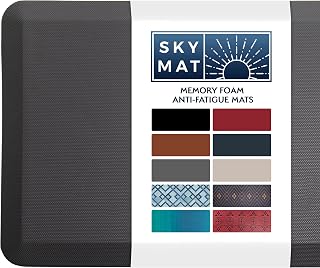
If your standing desk is cramped or you’re in an apartment, the 20×30 footprint is the sweet spot. Sky Solutions’ mat is designed for compact setups and doesn’t sacrifice comfort to fit the space. It’s 0.75 inches thick with a waffle-top texture and a rubber base.
Per aggregated Amazon reviews, users praise it for being lightweight (easy to move or store) and for not sliding around. The mat compresses slightly over time, as all budget foam does, but owner reports suggest it holds up reasonably well for 12-15 months of regular use. It’s also one of the quieter mats—no squeaking or popping sounds when you shift weight.
The trade-off: smaller footprint means less flexibility in where you stand. It’s ideal for someone who stands in one spot and doesn’t move much during the day.
Best for Hard Floors (Tile/Concrete): Ergofoam Anti-Fatigue Mat

Hard floors—tile, concrete, polished stone—are the worst for standing fatigue because there’s zero give. Ergofoam’s mat uses a denser foam blend specifically designed to resist compression on unforgiving surfaces. Per multiple owner reports on r/standingdesk and similar communities, users on concrete floors report less foot soreness with this mat than with softer gel or standard foam mats.
It comes in 24×36 inches, is 1 inch thick, and has a textured surface. The base is nonslip rubber. It’s heavier than thinner mats, so moving it is a two-person job if you’re rearranging, but that weight also means it won’t budge under your feet.
Downside: the density makes it feel less “cushy” at first—some users report it feels a bit firm for the first week. But that firmness is what keeps it supportive long-term.
Best for Renters: Topo by Ergodriven
Topo is a high-end mat that happens to fall in mid-tier pricing tiers. It’s included here because renters specifically benefit from its design: the textured, sculpted surface (it’s not flat) and beveled edges mean it won’t leave marks or damage on any floor type. You can roll it up, move it between apartments, and no landlord will notice it was ever there.
The sculpted surface isn’t just for looks—it forces more micro-movement than a flat mat, which can mean better circulation. Per owner reports, users find it more engaging to stand on than a plain mat. It’s 0.75 inches thick and comes in multiple sizes (20×30 and 24×36).
The catch: it’s pricier than other budget options, so you’re paying a premium for the design and renter-friendliness. If you own your home and don’t care about floor marks, you can save money elsewhere.
Best Budget Entry Point: PureRelief Premium Anti-Fatigue Mat
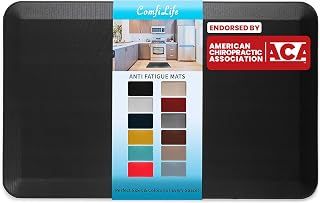
If you’re new to anti-fatigue mats and want to test the waters without spending much, PureRelief is solid. It’s 0.75 inches thick, comes in 20×30 and 24×36 sizes, and uses standard closed-cell foam. Per Amazon reviews, it’s one of the most affordable options and doesn’t feel cheap—the foam is reasonably dense, and the rubber base doesn’t slide.
It won’t win awards for durability or comfort, but it’s a functional mat that delivers the basics. Users report noticeable foot pain reduction in the first few weeks of use. After 12-18 months, expect some compression, but that’s par for the course at this price point.
This is the mat to buy if you’re skeptical about whether an anti-fatigue mat will help you, or if you’re on a tight budget and just need something functional.
Foam vs. Gel: What’s the Real Difference?
Most budget mats are foam. Gel mats are pricier but last longer. The short version: foam mats will compress over 12-18 months of daily use; gel mats hold shape longer but cost more upfront. If you’re buying you’re almost certainly getting foam, and that’s okay.
How to Maximize Comfort and Longevity
Rotate your standing position. Don’t stand in the exact same spot every day. Shift your weight side to side, or move your mat around the desk to use different sections. This spreads wear and keeps your body engaged.
Don’t stand motionless for 8 hours straight. Even the best mat is support, not a cure. Sit down for 20-30 minutes every 2-3 hours. Alternating sitting and standing is key to long-term comfort.
Keep it clean. Wipe down the mat weekly with a damp cloth. Dirt builds up and can degrade the surface. Never soak it.
Store it flat. If you need to move or store the mat, lay it flat rather than rolling it. Rolling can cause permanent creases in foam.
Pair it with proper footwear. Cushioned shoes or insoles make a huge difference. A mat alone won’t fix pain if you’re wearing thin-soled shoes.
Does an Anti-Fatigue Mat Actually Work?
Yes, but with caveats. Per aggregated user reviews on Amazon and Reddit, most users report measurable reduction in foot and leg fatigue within the first week of use. However, results depend on how much you stand, your footwear, and your baseline fitness. Someone standing 2-3 hours a day will see more benefit than someone standing 8+ hours straight.
The mat is not a replacement for proper ergonomics. If your desk is too high or too low, or if you’re standing in a hunched posture, a mat won’t fix that.
FAQ
How long do budget anti-fatigue mats last? Most budget foam mats last 12-18 months of daily 8-hour standing before noticeable compression. Gel mats and premium foam mats last 2-3 years. If you stand 4 hours a day or less, expect longer life.
Can I use an anti-fatigue mat on carpet? Yes, but the mat will shift more easily. Make sure the rubber base grips well, or use a nonslip rug pad underneath to keep it anchored. Per owner reports, mats on carpet feel slightly less stable than on hard floors.
What’s the best size for a standing desk? 24×36 inches is the standard and works for most desks. If your desk is under 4 feet wide, go 20×30. If it’s wider than 5 feet and you move around a lot, consider 36×48.
Do I really need a mat, or will an ergonomic chair help more? Both help, but differently. A mat reduces fatigue while standing; a chair provides support while sitting. If you’re alternating between sitting and standing, you need both.
Can I use an anti-fatigue mat with a standing desk converter? Yes. If you’re using a desk converter (a riser that sits on top of your existing desk), place the mat on the floor underneath. You’ll stand on the mat while using the elevated keyboard and monitor.
Bottom Line
If you stand 3–5 hours daily on a hard floor, the Ergofoam mat is the best value for durability. If you stand 8+ hours, the Imprint CumulusPro justifies its mid-range price with superior compression resistance. For small spaces, Sky Solutions delivers solid comfort without bulk. For renters, Topo’s sculpted design protects your floor. And if you’re just testing whether a mat helps, PureRelief is the entry point.
Pair your mat with proper desk height, an ergonomic chair for sitting breaks, and supportive shoes. That combination—not the mat alone—is what transforms standing-desk comfort.