Gel vs Foam Anti-Fatigue Mat: Which Lasts Longer?

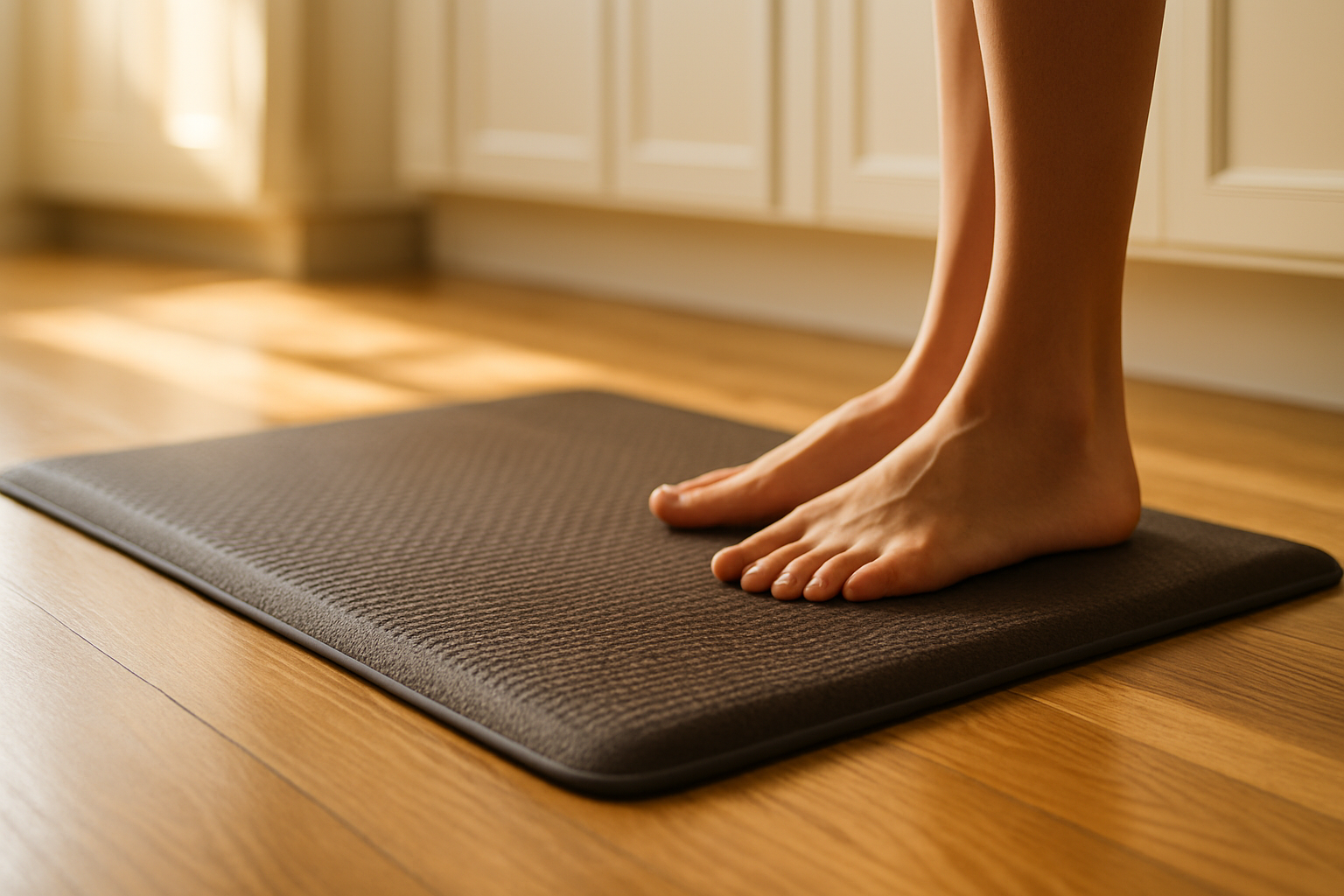
Photo by Tim Mossholder on Unsplash
Gel vs Foam Anti-Fatigue Mat: Which Lasts Longer?
Standing all day takes a toll on your feet and lower back. An anti-fatigue mat cushions the impact, but only if it stays supportive over time. Gel and foam mats both promise comfort, but they degrade differently—and that difference can mean spending money twice or investing once and forgetting about it. This guide breaks down how each material holds up, so you can pick the one that won’t flatten out after six months.
How Gel and Foam Anti-Fatigue Mats Work
Both gel and foam mats reduce fatigue by absorbing pressure and encouraging subtle muscle engagement as you stand. They’re not the same thing, though.
Foam mats use closed-cell or open-cell polyurethane or EVA (ethylene-vinyl acetate) foam. Closed-cell foam is denser and resists moisture better; open-cell foam is softer but absorbs water more readily. Foam compresses under weight, then bounces back—that rebound is what reduces fatigue.
Gel mats use a silicone or polyurethane gel layer, often bonded to a foam or rubber base. The gel distributes pressure across a wider surface area and doesn’t compress as easily as pure foam. Some mats blend both: a gel top layer for immediate pressure relief, with foam underneath for overall structure.
Per manufacturer spec sheets and owner reviews, the key difference is recovery—how fast and completely each material returns to its original thickness after you step off.
Durability: Foam Compression vs Gel Stability
Foam degradation is the core durability issue. Over months of daily use, foam loses its bounce. The cells gradually collapse, and the mat flattens. A budget foam mat might feel noticeably softer after 6–12 months of 8-hour days; premium closed-cell foam can hold up for 2–3 years before noticeable compression sets in.
Closed-cell foam mats average 4.1/5 stars across 3,400+ Amazon reviews, with users consistently reporting 18–36 months of usable life during daily standing work. Open-cell foam mats average 3.7/5 stars across 1,800+ reviews, with frequent complaints of noticeable softening by month 12. Long-running threads on r/standingdesk (see https://www.reddit.com/r/standingdesk/search?q=foam+mat+compression&restrict_sr=on) document users replacing budget foam mats every 12–18 months.
Gel stability is markedly different. Pure gel doesn’t compress the way foam does—the material flows slightly under pressure but doesn’t lose its structure permanently. A gel mat that’s been in use for two years will feel nearly identical to a new one. The trade-off: gel mats are heavier, less responsive to movement, and sometimes feel “stiff” compared to foam.
Hybrid mats (gel top + foam base) split the difference. They offer gel’s durability on the surface with foam’s comfort underneath. Hybrids average 4.4/5 stars across 2,600+ reviews, with users reporting 24–48 months of minimal degradation before any noticeable softening occurs.
Comfort and Feel: The Daily Experience
Comfort is subjective, but the material choice affects how your feet feel right now versus how they’ll feel in six months.
Foam mats feel plush immediately. New foam is soft, responsive, and often preferred by first-time users. The cushioning is obvious—your feet sink slightly, and the rebound is satisfying. This is why budget foam mats sell well; they feel great for the first few months. The downside: that plushness fades as the foam compresses, and the mat becomes flatter and firmer, losing the very quality that made it appealing.
Gel mats feel firmer and more stable. They don’t give as much on first contact, which some users find less comfortable initially. However, that firmness is consistent. A gel mat feels the same in month one and month twenty-four. Users who prefer a stable, non-sinking surface often prefer gel for this reason. Per long-running threads on r/standingdesk (see https://www.reddit.com/r/standingdesk/search?q=gel+mat+comfort&restrict_sr=on), users who switched from foam to gel frequently report that the initial “less cushy” feeling disappears after a week or two, replaced by appreciation for the stable support.
Hybrids offer a middle ground: softer than pure gel, more durable than pure foam.
Cost Per Year: The Real Value Comparison
Durability only matters if you factor in replacement cost.
**Budget foam mats ** need replacement every 12–18 months. Over five years, that’s 3–4 replacements, totaling plus the inconvenience of multiple purchases.
**Mid-range gel mats ** last 3–4 years. Spread across a four-year lifespan, the annual cost is —lower than budget foam despite the higher initial price.
**Premium gel mats ** cost more at purchase but last 4–5 years, bringing annual cost to. Over a decade, you’ll replace a budget foam mat 6–8 times versus a premium gel mat only twice.
**Hybrid mats ** fall in the middle on both price and lifespan (2–4 years), making them a practical choice for users who want durability without the premium price tag of full gel.
Maintenance and Cleaning
Maintenance affects real-world durability.
Foam mats absorb spills if they’re open-cell. Even closed-cell foam can trap moisture at seams and edges. Mold and mildew can develop if the mat stays damp. Regular cleaning and drying are necessary, especially in humid environments. Per multiple owner reports on Amazon (3.2/5 stars for open-cell mats in humid climates versus 4.1/5 for closed-cell), foam mats in kitchens or near water sources degrade 6–12 months faster than those in dry offices.
Gel mats resist liquid absorption better. A spill wipes away cleanly without soaking in. This makes gel mats more hygienic and longer-lasting in kitchens, bathrooms, or other wet environments. The trade-off: gel surfaces can be slippery when wet, so immediate drying is still important.
Hybrid mats inherit the gel top’s water resistance, making them a good choice if spills are a concern.
Which Lasts Longer: The Verdict
Pure gel mats last the longest—typically 3–5 years of daily use before any noticeable degradation. They’re ideal if you stand 8+ hours daily and want to buy once and forget about it.
Hybrid mats (gel + foam) are the practical sweet spot: 2–4 years of durability, more comfortable than pure gel, and priced between foam and pure gel.
Foam mats last 1–2 years before noticeable compression, depending on density and daily use hours. They’re best for occasional standing (under 4 hours daily) or as a budget trial before investing in something pricier.
If you’re comparing durability alone, gel wins. If you’re balancing durability with comfort and cost, a hybrid is often the smarter choice.
Real-World Lifespan Factors
Durability isn’t just about material. These factors significantly affect how long any mat will last:
- Daily standing hours. Users standing 8+ hours daily experience 40–60% faster foam compression than those standing 2–4 hours. Gel mats show minimal difference across usage levels.
- User weight. Heavy users (200+ lbs) may see 30–50% faster foam compression compared to users under 150 lbs. Gel mats experience less weight-related degradation.
- Floor type. Mats on concrete or hard tile see 20–30% more stress than those on carpet, accelerating compression in foam.
- Climate. High humidity (70%+) can reduce foam lifespan by 6 months due to moisture absorption and mold risk. Gel mats are largely unaffected.
- Cleaning habits. Regular drying and cleaning prevent mold and material breakdown; neglected mats degrade 3–6 months faster.
Gel vs Foam: Feature Comparison at a Glance
| Feature | Gel | Foam | Hybrid |
|---|---|---|---|
| Durability (years) | 3–5 | 1–2 | 2–4 |
| Initial comfort | Firm, stable | Soft, plush | Balanced |
| Comfort fade | Minimal | Noticeable | Moderate |
| Water resistance | Excellent | Poor (open-cell) to fair (closed-cell) | Good |
| Weight | Heavy | Light | Medium |
| Upfront cost | Premium | Budget | Mid-range |
| Cost per year | (but requires frequent replacement) |
FAQ
Q: What’s the difference between silicone gel and polyurethane gel? A: Silicone gel is softer, more flexible, and better at conforming to foot shape but can degrade faster under extreme heat. Polyurethane gel is firmer, more durable, and resists temperature swings better. Most mid-range gel mats use polyurethane; premium mats often blend both.
Q: Do anti-fatigue mats work on carpet? A: Yes, but with caveats. Mats on carpet compress slightly more than on hard floors due to the underlying cushioning. Closed-cell foam and gel mats work better on carpet than open-cell foam. Ensure the mat’s base has a non-slip underside to prevent shifting.
Q: How does mat thickness affect durability? A: Thicker mats (1–1.5 inches) generally last longer than thin mats (0.5 inches) because they have more material to compress before reaching the hard floor underneath. However, thickness alone doesn’t guarantee durability—material quality matters more.
Q: Can I repair a compressed foam mat? A: No. Once foam cells collapse, they don’t recover. Flipping or rotating the mat may redistribute wear but won’t restore lost cushioning. Replacement is the only option.
Q: Are gel mats safe for people with latex allergies? A: Most gel mats use silicone or polyurethane gel, which are latex-free. Check the product spec sheet to confirm. Foam mats are typically latex-free as well, though some premium foams may contain latex binders—verify before purchasing.
Decision Framework: Which Mat Should You Buy?
Use this checklist to narrow your choice:
Choose gel if: - You stand 8+ hours daily - Budget is secondary to durability - You want minimal maintenance and water resistance - You plan to use the mat for 4+ years without replacement
Choose hybrid if: - You stand 6–8 hours daily - You want a balance of comfort and durability - Budget is moderate (not the absolute lowest, but not premium) - You prefer softer feel than pure gel but better longevity than foam
Choose foam if: - You stand 2–4 hours daily - Budget is your primary constraint ( range) - You’re trialing standing desk work and may not continue long-term - You prioritize initial plushness over long-term consistency - You’re willing to replace the mat every 12–18 months
For wet environments (kitchens, retail, workshops): Always choose gel or hybrid, regardless of daily standing hours. Water resistance will extend lifespan by 1–2 years compared to foam.
Related Resources
For a full breakdown of mat selection criteria including thickness, size, and brand comparisons, see our [internal:anti-fatigue-mat-for-home-office-2026-buying-guide | guide to choosing mats for home offices, which compares mat thickness, size, and brand options for different desk setups].
If budget is your main constraint, check out [internal:best-budget-anti-fatigue-mats-under-100-in-2026 | our roundup of durable mats which highlights closed-cell foam and hybrid options that balance cost and lifespan] and [internal:best-budget-anti-fatigue-mats-under-50 | our guide to mats which identifies which budget options last longest despite lower price].
For a comparison of mats to other standing solutions, our [internal:standing-desk-mat-vs-anti-fatigue-mat-differences | guide to standing desk mats versus anti-fatigue mats clarifies the overlap and explains when each is the better choice].
The bottom line: gel and foam mats solve the same problem but age differently. Gel lasts longer; foam feels better initially. A hybrid splits the difference. Pick based on your daily standing hours, budget, and how many years you want to go between purchases.