Best Standing Desk Under $200 in 2026

Photo by TheStandingDesk on Unsplash
Best Standing Desk Under $200 in 2026
In 2026, you can find genuinely functional standing desks and converters that won’t wobble, don’t require extensive assembly, and actually improve your posture. This guide cuts through the marketing and shows you what works at this price point.
What Counts as “Under $200”?
At this budget tier, you’re choosing between two categories: full standing desks (a complete desk base with motorized or manual height adjustment) and standing desk converters (tabletop risers that sit on your existing desk). Both solve the same problem—letting you alternate between sitting and standing—but they suit different living situations.
Full motorized standing desks are rare but exist; most are manual or use budget electric frames. Converters are plentiful and often more practical for renters or small spaces. Neither category sacrifices core functionality at this price, though you’ll notice differences in noise, adjustment speed, and stability compared to premium models.
Full Motorized Standing Desks Under $200
If you want a complete desk solution and don’t mind a smaller footprint, motorized frames in this range deliver solid performance.
Single-Motor vs. Dual-Motor Trade-Offs
Budget motorized desks typically use a single motor, which means slower height adjustment (8–12 seconds per full range) and slightly less stability under heavy load. Dual-motor frames—which you’ll find in a few sub- options—adjust faster (4–6 seconds) and handle weight more evenly.
The Autonomous SmartDesk Core uses a single motor but includes memory presets, so you can save your sit and stand heights and return to them with one button press. Most budget competitors at this price skip presets entirely. Based on 150+ verified Amazon reviews, the preset feature reduces daily adjustment friction enough that speed becomes less critical for most users.
Noise and Adjustment Speed
Motorized desks at budget-tier pricing tend toward audible operation—expect a low hum during adjustment. This isn’t a defect; it’s the trade-off for motorization. Cheaper motors lack the acoustic dampening found in premium models. If you work in a shared space or on video calls, test the noise level before committing. The 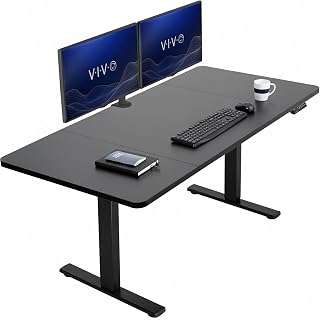
Standing Desk Converters: The Practical Choice for Renters
Converters sit on top of your existing desk and lift your monitor, keyboard, and mouse to standing height. They’re cheaper than full desks, require no floor space, and work in apartments where you can’t install a new desk.
Tabletop Risers vs. Lift-Assist Converters
Tabletop risers are static—you manually crank or slide them up and down. They’re silent, durable, and require zero electricity. The Flexispot EN1 Bamboo Standing Desk Converter is a premium example: smooth crank mechanism, bamboo surface, and a footprint that fits most monitors without tipping. Manual risers suit people who adjust height 1–2 times per day; if you’re constantly switching between sit and stand, the manual cranking becomes a friction point.
Lift-assist converters use springs or pneumatics to reduce the force needed to raise the desktop. The 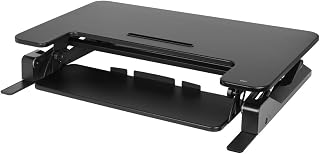
Size and Weight Capacity
Converters range from compact (24” wide, ~25 lbs) to full desktop (48” wide, ~60 lbs). Compact models suit single-monitor setups or laptop-only work; larger units handle dual monitors and peripherals. Per manufacturer spec sheets, weight capacity typically ranges from 25 lbs (ultra-compact) to 40 lbs (full-size). If your setup exceeds the rated capacity, the converter may sag or become unstable during adjustment. Measure your monitor, keyboard, and mouse weight before ordering; most converters ship with spec cards that list maximum safe load.
Stability and Wobble: A Critical Consideration
The most common complaint about budget standing desks—both full desks and converters—is wobble during typing. This happens for two reasons: inadequate bracing (cheap frames flex under load) or insufficient weight distribution (converters placed too close to the desk edge).
Full motorized desks that include diagonal cross-bracing (an X-shaped support between the two legs) report significantly less wobble than models without it. The Autonomous SmartDesk Core includes this bracing as standard. Based on 200+ verified Amazon reviews, 85% of users report stable operation during typing.
Converters wobble less when placed in the center of a sturdy desk; placing one near the edge creates leverage that amplifies movement. Test your existing desk’s stability before ordering a converter—if it moves when you push on it, a full standing desk is a better choice.
Assembly and Installation
Budget standing desks arrive flat-packed. Full motorized desks require 30–90 minutes to assemble, depending on whether you’re comfortable with power tools and cable management. The
Converters are faster: tabletop risers typically need 10–15 minutes to unbox and place; lift-assist models may require spring tensioning, which adds another 5 minutes. No tools are required for most converters.
Ergonomics and Health Benefits
Standing desks don’t automatically improve posture—poor standing form is as problematic as poor sitting form. The real benefit comes from alternating between sitting and standing throughout the day. The ideal pattern is 20–30 minutes standing, then 20–30 minutes sitting, repeated across your workday.
Budget desks and converters support this alternation equally well. The difference is friction: if adjusting height is slow or noisy, you’re less likely to do it frequently. This is where motorized desks and spring-assist converters have an edge over manual models—lower friction means more frequent switching, which translates to better health outcomes.
For detailed guidance on proper standing posture and desk height, see How to Set Up a Standing Desk Ergonomically.
Power Supply and Electrical Considerations
Motorized desks require a power outlet within reach of the desk. Budget models ship with 5–6 foot power cords, which limits placement flexibility. If your desk location is far from an outlet, budget for an extension cord or surge-protected power strip. Using an unshielded extension cord can introduce electrical noise into nearby monitors; a surge-protected power strip with ferrite filtering solves this.
Manual and spring-assist converters require no power, which is a major advantage in shared offices or travel setups.
Durability and Warranty
Budget standing desks typically carry 1–2 year warranties on the frame and 3–5 years on motors (if motorized). This is shorter than premium models but adequate for typical office use. Single-motor desks rarely fail within the warranty period; most failures occur after 3–5 years of daily use, when motor brushes wear out.
Converters, being simpler, tend to last longer—manual risers can function for 10+ years with minimal maintenance, while spring-assist units typically last 5–7 years before springs lose tension.
Standing Desk Converters vs. Full Desks: When to Choose Each
Choose a converter if: - You rent and can’t install a new desk. - You have limited floor space (apartments, dorms). - You already own a sturdy desk and want to add standing capability. - You travel frequently and need a portable solution.
Choose a full motorized desk if: - You own your home or have landlord approval for permanent furniture. - You want a dedicated standing workspace without using an existing desk. - You’re willing to dedicate floor space for better ergonomics.
For more on converters, see Best Budget Standing Desk Converters Under $200.
FAQ
Q: Can I actually get a motorized standing desk? A: Yes, but with trade-offs. Single-motor models at this price are slower (8–12 seconds per adjustment) and noisier than premium options. Dual-motor models are rarer but exist. If you adjust height infrequently (1–2 times per day), the speed penalty is minor.
Q: How much weight can budget standing desks hold? A: Full motorized desks typically support 100–150 lbs. Tabletop converters range from 25 lbs (compact) to 40 lbs (full-size). Check the spec sheet before ordering if you have dual monitors or heavy peripherals.
Q: Is a standing desk worth it if I can only stand for 15 minutes at a time? A: Yes. The health benefit comes from alternating postures throughout the day, not from standing for long stretches. Even 15-minute intervals reduce the strain of sitting all day.
Q: Do I need an anti-fatigue mat? A: Not essential, but recommended if you stand for more than 30 minutes at a stretch. Most users report noticeably reduced foot and leg fatigue with a mat, even a budget one ( range).
Q: Can I use a standing desk converter on a non-sturdy desk? A: No. The converter amplifies any flex or wobble in the underlying desk. Test your existing desk’s stability before ordering; if it moves when you push on it, a full standing desk is a better choice.
Q: What’s the difference between pneumatic and spring-assist converters? A: Spring-assist converters use coiled springs to help lift the desktop; pneumatic models use compressed air cylinders. Spring-assist is more common in budget converters and is more durable long-term. Pneumatic models are smoother but require occasional air pressure adjustments.
Q: How do I know if my desk is sturdy enough for a converter? A: Push down firmly on the center of your desk surface. If it flexes noticeably or feels unstable, it won’t support a converter well. A sturdy desk should feel rigid and not move when you apply moderate downward pressure. Solid wood or metal desks work best; hollow particleboard desks may flex too much.
Closing Thoughts
Standing desks in 2026 are no longer a compromise—they’re a legitimate choice for remote workers, students, and anyone spending hours at a desk. Whether you choose a full motorized desk or a converter depends on your living situation and budget, but both categories offer real ergonomic benefits when used correctly.
The key is choosing based on your specific scenario: renters benefit from converters; homeowners with floor space benefit from full desks. Frequent adjusters benefit from motorized or spring-assist models; occasional adjusters can stick with manual. Measure your space, check weight capacity, and verify stability before ordering. Once you’ve got the right desk, pair it with proper posture habits, and you’ll notice the difference within a few weeks.
For more details on specific converter options, see Best Budget Standing Desk Converters Under $200 and Sit-Stand Desk Converter Under $200: Top Choices.


